
Barium or strontium sulfate risk
Compare the source waters and quantify barium, strontium and sulfate before they mix. High-salinity compatibility and the intended injection or squeeze route are central to the inhibitor screen.
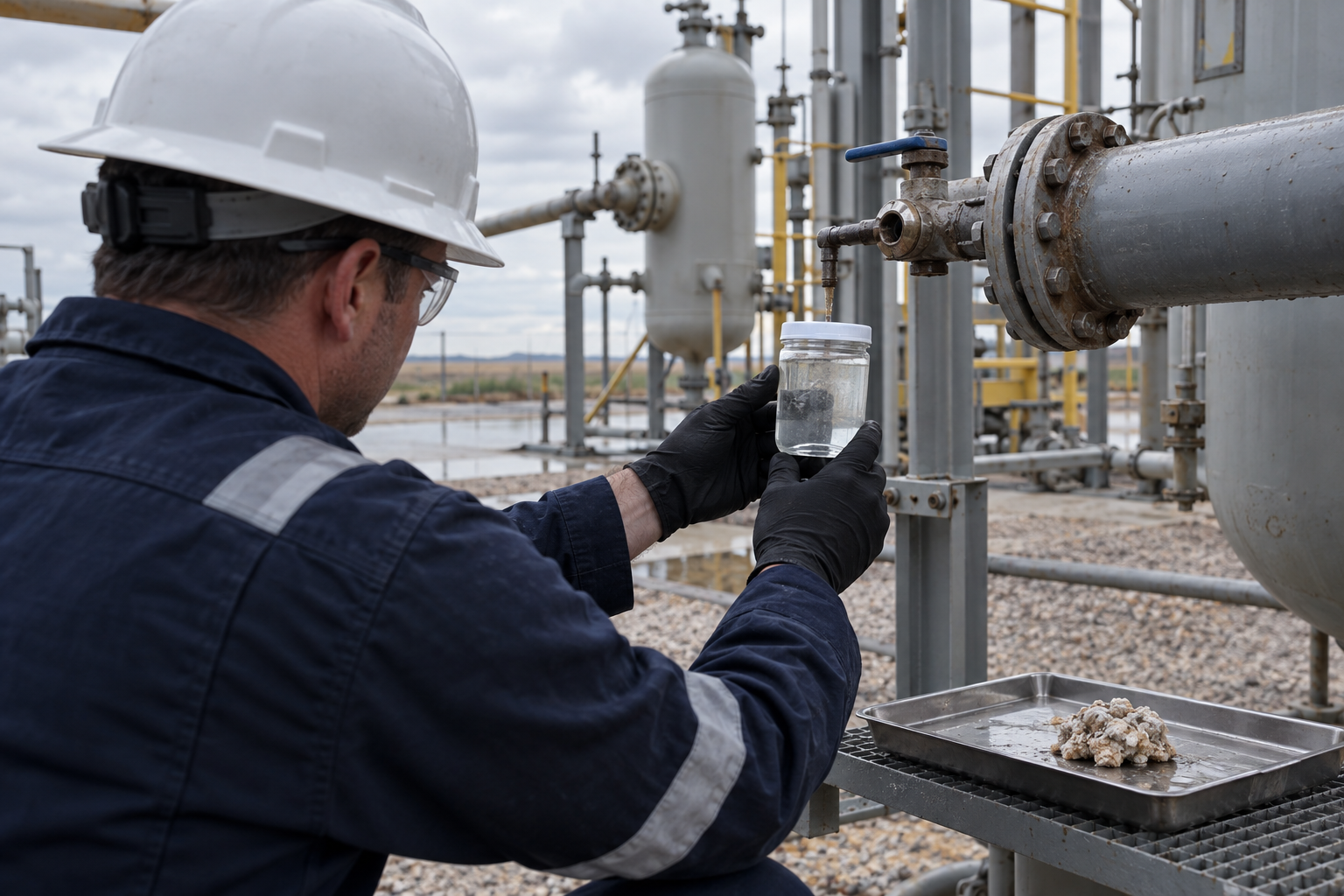
Choose chemistry from the produced-water or injection-water conditions. Brine composition, scale tendency, microbial activity, metallurgy, temperature, pressure and the intended injection route determine whether the first conversation is about scale control, corrosion control or microbial control.
Each route begins with a different mechanism and a different set of useful inputs.
Compare the source waters and quantify barium, strontium and sulfate before they mix. High-salinity compatibility and the intended injection or squeeze route are central to the inhibitor screen.
Use calcium, alkalinity, pH, temperature, pressure change and deposit analysis to distinguish carbonate scale from iron-rich or mixed deposits before selecting the candidate chemistry.
Locate the microbial problem and define contact conditions, materials, salinity and the current program. Then compare biocide families for the intended water and delivery route.
Use these product families as a shortlist for comparison—not as interchangeable substitutes.
Start with the brine analysis, scale species and injection method. WT-607 and WT-607B are candidate routes for different oilfield scale-control discussions.
Review WT-607ATMP, DTPMP, HEDP and PBTC differ in structure and operating fit. Compare them only after the scale risk and water compatibility are defined.
Compare phosphonatesTHPS, glutaraldehyde and quaternary ammonium chemistry provide different starting points for microbial-control screening.
Explore biocidesIdentify produced water, source water, commingled water and the point where chemistry or pressure changes.
Use paired water analyses, deposit composition, microbial data and the failure location.
Compare continuous injection, batch or squeeze requirements with temperature, pressure and compatibility.
Use a representative brine test and measurable operating response before extending the treatment.
Use complete source-water and produced-water analyses, expected mixing ratios, temperature, pressure, flow path, scale or deposit composition and the intended continuous-injection or squeeze route.
WT-607B is a candidate for discussions involving barium and strontium scale risk. Its fit still needs to be screened against the actual brine, operating conditions and delivery route.
Compare the microbial target, salinity, temperature, contact time, metallurgy, discharge constraints and compatibility with the existing program before narrowing THPS, glutaraldehyde or quaternary-ammonium routes.
No. Scale, corrosion, suspended solids and microbial growth have different mechanisms. Define the dominant problem and water path first, then build a compatible treatment program.
Start from the water path and the buyer decision, not a chemical name. For produced-water clarification, classify free oil, coarse solids, fine particles, iron and biological material before matching conditioning to flotation, settling or filtration. Before two injection-water sources are blended, establish separate source analyses, the full ratio envelope and the first commingling point.
| Buyer trigger | Use this guide | Evidence for the next step |
|---|---|---|
| Suspended solids or dispersed oil must be clarified | Choose the clarification and separation sequence | Representative feed, oil/solids/iron classification, actual separator and downstream endpoint |
| A new source or blend ratio will enter injection service | Map mixed-water scale compatibility | Separate source analyses, ratio sweep, mixing map, static/dynamic evidence and stop conditions |
Related identity pages include PAC, PAM, WT-607 and WT-607B. Their presence does not establish a site dose or compatibility. Review the video and evidence library, then share the water, equipment and acceptance evidence.