
Application / lab test
Spray Booth Wastewater Jar Test: Paint-Mist Flocculant + PAM
This jar-test video shows a two-stage screen for sticky spray-booth wastewater. A paint-mist treatment first contacts the dispersed overspray, then PAM is added to bridge conditioned particles into larger flocs for separation. The useful buying question is not simply whether flocs appear; it is which sequence and polymer grade produce removable, less-sticky solids in the actual recirculating booth water. Buyers should send the paint or coating type, booth additives, pH, solids or turbidity, circulation history and separation equipment before requesting matched samples or planning a supervised plant trial.
Watch on YouTube Published
What this video shows
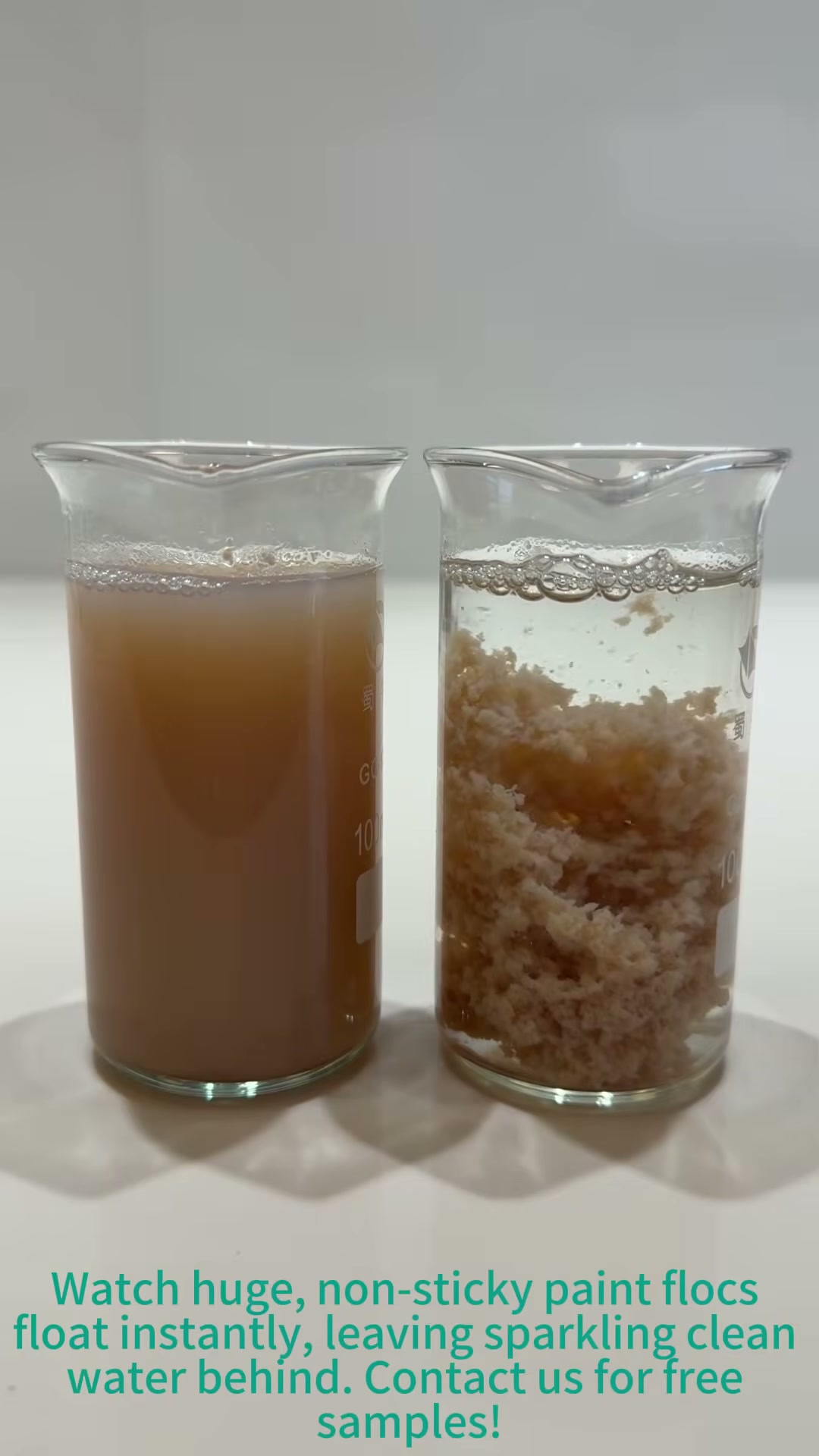
For sticky spray-booth wastewater, screen the treatment in two stages: first use the paint-mist flocculant shown in the video to detach and capture overspray, then add a suitable PAM grade to bridge the destabilized particles. The clip shows larger, less-sticky flocs and a clearer liquid phase after the polymer step. Final product choice starts with the actual paint and booth-water sample.
What happens in the beakers
The Short follows two samples of brown booth water. The first addition contacts the dispersed paint solids; mixing exposes the overspray to the paint-mist treatment. PAM is added afterward, and the small destabilized particles gather into larger flocs that can be separated from the water.
The sequence matters. Adding a bridging polymer before the paint particles have been conditioned can trap sticky material without creating a manageable separated phase. The visible result is therefore useful for deciding which sequence to screen, while the winning combination is selected from parallel beakers using the site's real water.
Build a useful sample test
Send a representative sample together with the paint or coating type, water source, current additives, pH, solids or turbidity data, booth recirculation history and the intended separation equipment. In the lab, compare an untreated control, the paint-mist product by itself, and the same product followed by candidate PAM grades.
Record mixing order, floc texture, stickiness, settling or flotation behavior and the clarity of the separated liquid. For a recirculating booth, also examine whether the recovered solids can be removed without coating pumps, screens or tank walls.
Where PAM fits
Polyacrylamide is the exact catalog product family used for the bridging step. VCYCLETECH's product page lists anionic, cationic and nonionic powder grades with solids of at least 90%; the suitable ionic type and molecular profile depend on the conditioned paint particles. PAM is not presented here as a substitute for the first paint-mist treatment.
Plan the first booth trial
Move from beakers to the recirculating booth in a short, supervised trial. Establish the normal tank condition first, then note the feed points, circulation time and solids-removal interval. Operators should watch paint detackification, screen loading, pump behavior, foam and the condition of recovered solids. Keep one operating period on the current program as a comparison.
Define stop conditions before dosing begins, including excessive foam, sticky deposits or poor solids removal. Collect before-and-after samples at consistent locations. The result should support a specific operating decision: continue screening, adjust the sequence, change the polymer grade or return to the previous program.
Product and process details
These fields summarize the product, process or shipment context shown in the video and linked catalog.
| Field | Value | Source |
|---|---|---|
| Available catalog forms | Anionic, cationic and nonionic powder grades | Product page |
| Appearance | White granular powder | Product page |
| Particle diameter | <2 mm | Product page |
| Solids | ≥90% | Product page |
| Molecular-weight range | 2–18 million, depending on ionic type | Product page |
| Hydrolysis range | 5–60%, depending on ionic type | Product page |
Conditioning alone vs conditioning plus PAM
The two stages perform different jobs and should be compared with untreated and single-stage controls.
| Test condition | Primary purpose | What to observe |
|---|---|---|
| Untreated control | Baseline | Stickiness, solids and separation |
| Paint-mist treatment | Condition dispersed overspray | Detackification and particle response |
| Treatment + PAM | Build separable flocs | Floc strength, flotation or settling |
| Plant trial | Confirm operating fit | Screens, pumps, foam and solids removal |
Spray-booth sample-to-trial flow
Which spray-booth data determines the sample set?
The paint system and recirculating-water condition determine which first-stage treatment and PAM grades deserve testing.
- Paint or coating chemistry
- Current booth additives and water source
- pH, solids or turbidity and operating history
- Flotation, skimming or settling equipment
- Desired solids-removal and water-reuse outcome
Common questions
What does the spray-booth jar test show?
It shows a paint-mist treatment followed by PAM, with visible formation of larger separable flocs.
Should PAM be added before the paint-mist treatment?
The demonstrated sequence conditions the paint first and adds PAM second; compare controls before transferring it to the booth.
Which PAM grade should be used?
Select the ionic type and molecular profile through tests on representative booth water and the conditioned paint solids.
What should be measured besides water clarity?
Record floc stickiness, settling or flotation, recovered-solids handling, foam and effects on screens and pumps.
How can a buyer request a spray-booth test?
Send a representative sample brief with paint type, current additives, water data and separation equipment.